
Unseen Disruption: The Emergence of Generic GLP-1 Weight-Loss Drugs and Its Structural Implications
As blockbuster diet drugs like Novo Nordisk’s semaglutide lose patent exclusivity, an under-recognized wave of affordable generic alternatives is poised to disrupt global pharmaceutical markets and healthcare regulation. This paper identifies the nascent expansion of low-cost GLP-1 receptor agonists outside dominant pharma ecosystems as a non-obvious inflection point with profound implications for capital allocation, regulatory models, and industrial structure over the next two decades.
The convergence of patent expirations, telehealth-driven generics launch, and uneven patent protections across emerging markets signals more than incremental price competition. Instead, it suggests a potential overhaul of who controls access to, and benefits from, weight-loss therapeutics. This shift could recalibrate global supply chains, challenge incumbent brand owners, and pressure regulatory authorities to adapt frameworks around drug approval, intellectual property enforcement, and telehealth distribution.
Signal Identification
This development qualifies as an emerging inflection indicator, as it currently manifests in fragmented but accelerating phenomena that could scale into systemic disruption within 5–20 years. Its plausibility is high given the convergence of documented patent expiry timelines, telehealth platform initiatives, and regulatory enforcement actions. Key sectors exposed include pharmaceutical manufacturing, healthcare delivery, telemedicine, intellectual property law, and regulatory governance.
The timeline bifurcates: near-term (5–10 years) witnessing price compression and diffusion of generics in emerging markets, and medium-term (10–20 years) structural shifts in global pharma-industrial ecosystems and regulatory standards.
What Is Changing
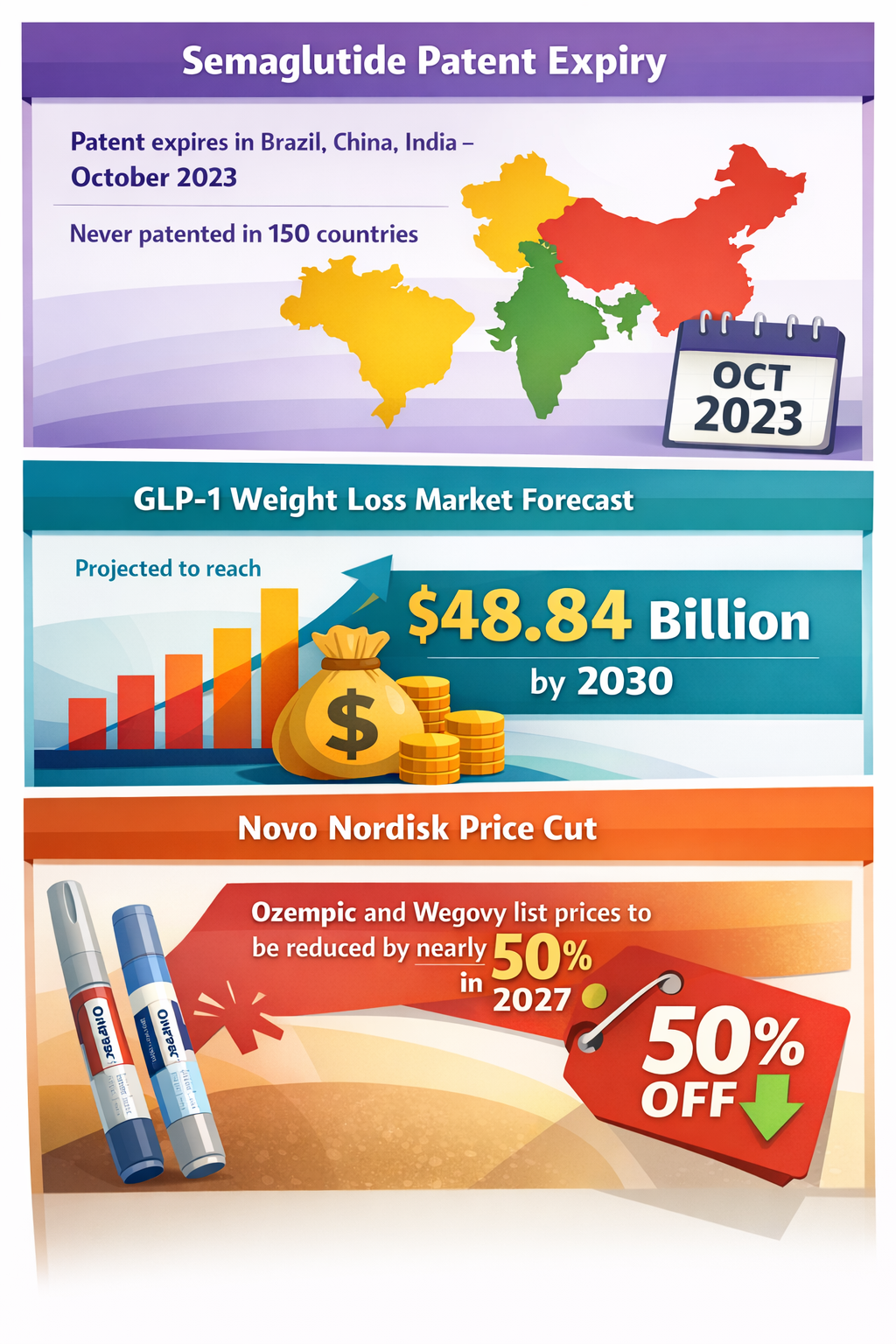
Semaglutide, a leading glucagon-like peptide-1 (GLP-1) receptor agonist utilized in weight management (branded as Wegovy and Ozempic), will lose patent protection imminently or already has in significant countries like Brazil, China, and India, also lacking patent in 150 others (ScienceAlert 23/06/2024). This global patent gap is a critical enabler for off-patent generic manufacturing and distribution outside established Western pharmaceutical strongholds.
Compounding this, telehealth providers such as Hims & Hers have announced launching generic versions of Wegovy at nearly half the incumbent price, disrupting not just the physical supply chain but also the commercial and prescribing models (CNBC 05/02/2026). This innovation in delivery channels leverages telemedicine's vertical integration with prescription fulfillment, broadening patient access and potentially decentralizing pharmaceutical distribution.
Novo Nordisk’s own strategic price cuts from 2027, reducing list prices by nearly 50% for their key products, signal recognition of incoming pricing pressure, further validating competition from generics and telehealth models (Slepkow Law 15/03/2024). However, these cuts may be insufficient to stem erosion of market share in the face of aggressively priced generics.
The Food and Drug Administration’s (FDA) recent statement about enforcement action against non-FDA-approved GLP-1 active pharmaceutical ingredients underscores the regulatory friction in this emergent landscape (Debrunner Policy Update 12/02/2026). This reflects a systemic tension between protecting drug safety and efficacy standards and responding to legitimate market demands for affordable access via non-traditional supply chains.
The recurring theme beyond price decline is the systematic weakening of patent-based exclusivity layered further by non-traditional, decentralized distribution channels leveraging telehealth models. This is creating a novel intersection where intellectual property law, digital health, and global manufacturing converge—systems traditionally siloed are now colliding and co-evolving.
Disruption Pathway
The push for affordable generics is enabled by patent expirations and the absence of patent protections in vast swathes of global markets. As generic producers in cost-advantaged countries ramp up manufacturing capabilities, they may flood both local and export markets with cheaper alternatives, including via telehealth platforms that bypass traditional pharmacy and insurer gatekeepers.
This expanded supply intensifies competitive pressure on incumbent pharma firms forced either to compete on price or innovate new molecular candidates to maintain profitability. Novo Nordisk’s announced price cuts may slow but not prevent erosion of revenue and market dominance.
Enforcement actions by regulators like the FDA against unauthorized ingredients and distribution channels may initially slow proliferation but face increasing enforcement complexity as cross-border supply chains and online platforms proliferate. Regulatory frameworks built on rigid, nationally bounded approval processes may become increasingly inadequate in policing an evolving digital and globalized pharmaceutical supply landscape.
Pharmaceutical companies and regulators may need to adapt by collaborating on new standards for decentralized clinical validation, supply chain transparency technologies (e.g., blockchain), and agile regulatory review processes to retain control and consumer safety while accommodating affordable generics distributed through innovative channels.
Failing this, systemic fragmentation may ensue, fragmenting the market into regulated premium segments and less-regulated, often cheaper generic/telehealth segments. This dynamic risks increasing liability risks and potential public health challenges if substandard or unsafe generics circulate unchecked, triggering regulatory and reputational crises.
Over the medium term, capital flows could increasingly shift toward generic manufacturers leveraging lower-cost regions and telehealth startups pioneering new delivery models. Incumbent pharmaceutical firms may consolidate, divest, or pivot toward platform-based business models (e.g., proprietary digital therapeutics, outcome-based pricing schemes) to mitigate commoditization risks.
Why This Matters
This signal is crucial for decision-makers orchestrating capital deployment in pharmaceutical R&D, manufacturing, and healthcare platforms. Investors must anticipate margin compression in the branded GLP-1 segment and rising opportunity in generic production aligned with telehealth distribution.
Regulators face a growing imperative to recalibrate approval and enforcement frameworks to balance access, safety, and innovation incentives globally. Digital health stakeholders must navigate complex compliance environments increasingly shaped by drug access battles and cross-border supply chain dynamics.
Supply chains may witness rerouting towards emerging economies with pharmaceutical industrial bases, altering geopolitical dependencies and manufacturing localization strategies.
Liability frameworks and governance models may need reform to address risks arising from distributed, digitally enabled pharmaceutical distribution networks outside traditional oversight mechanisms.
Implications
This trend could likely catalyze structural realignment in the pharmaceutical-industrial complex. It may force shifts away from patent-centric business models toward integrated digital health and generics supply chain platforms.
Capital markets could increasingly favor low-cost, high-volume generic producers with scalable telehealth distribution channels over brand-driven incumbents.
Regulatory frameworks might evolve to embrace more dynamic, digitally-enabled approval and quality control paradigms, potentially through international cooperation to standardize generics verification in cross-border contexts.
However, this development is not a guaranteed collapse of branded pharmaceutical power but a credible pressure that incumbent firms will counter with price adjustments, lobbying for stricter enforcement, or innovating new drugs with extended IP protection.
Competing interpretations may argue this reflects routine pharma lifecycle dynamics rather than a true paradigm shift, but the simultaneous convergence of patent expiry, telehealth empowerment, and regulatory tension distinguishes this as more than incremental change.
Early Indicators to Monitor
- Increase in generic GLP-1 drug patent filings or manufacturing capacity announcements in emerging markets
- Surge in venture capital or private equity funding targeting telehealth platforms offering weight-loss generics
- Regulatory proposals or international discussions on harmonizing approval standards for generic biologics and telehealth-distributed pharmaceuticals
- Market share migration from branded GLP-1 drugs to generics in diverse geographies
- Public enforcement actions or clarifications regarding cross-border supply and unauthorized ingredient use in GLP-1 drugs
Disconfirming Signals
- Extension of patent exclusivities or successful legal challenges limiting generic production in key markets
- Significant technological or cost breakthroughs by incumbents making branded GLP-1 drugs unbeatable on price or efficacy
- Regulatory clampdowns leading to large-scale removal of non-approved generics and telehealth distributors from the market
- Substantial safety or efficacy failures in generic GLP-1 products causing market retraction
- Global macroeconomic shocks severely restricting capital deployment in telehealth or generics manufacturing
Strategic Questions
- How should pharmaceutical incumbents restructure R&D and distribution investments to hedge against accelerating generic and telehealth-enabled competition?
- What regulatory innovations are required to maintain drug safety and intellectual property balance as decentralized, cross-border generic weight-loss drugs proliferate?
Keywords
GLP-1; semaglutide; weight loss drugs; generic pharmaceuticals; patent expiry; telehealth; pharmaceutical regulation; drug distribution; intellectual property; biologics
Bibliography
- Semaglutide will lose patent protection in countries such as Brazil, China, and India later this month, and researchers identified 150 countries where it was never patented. ScienceAlert. Published 23/06/2024.
- Novo Nordisk has announced that it intends to cut Ozempic and Wegovy list prices nearly 50% commencing in 2027. Slepkow Law. Published 15/03/2024.
- Shares of the pharmaceutical company dropped after telehealth company Hims & Hers announced it will launch a generic version of Novo Nordisk 's new Wegovy weight-loss pill for $49 a month, $100 cheaper than Wegovy's price tag. CNBC. Published 05/02/2026.
- The FDA announced that it will take enforcement action against non-FDA-approved GLP-1 active pharmaceutical ingredients. Debrunner Policy Update. Published 12/02/2026.
- Analysis of telehealth and generic distribution impact on pharmaceutical markets. CNBC. Published 05/02/2026.